search
Shop Sign In
cart

Between the Wars
As early as 1919 the Tank Corps started to contract in size while at the same time the places in which it was deployed increased. In early 1919, three small tank detachments were dispatched to Russia – to the South, the North, and to Estonia – to support the White Russians against the Bolsheviks. The largest of these was in the South and their actions included the capture of Tsaritsin, later called Stalingrad, now known as Volgograd. And in 1920 the Tank Corps, which was now a central depot, four tank battalions (the 2nd, 3rd, 4th and 5th Battalions), and nine armoured car companies, were deployed to Ireland, Germany, Iraq, Persia, Palestine, and India.
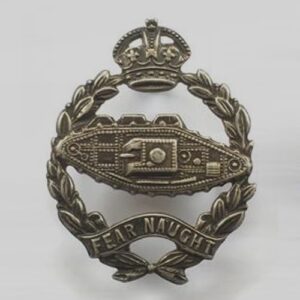
An important change took place in 1923, when the Royal Tank Corps (RTC) was created with HM King Charles V as Colonel-in-Chief. It was at this time that the motto ‘Fear Naught’, the black beret and the unit badge were adopted. And then in 1939, on the formation of the Royal Armoured Corps, the RTC became Royal Tank Regiment.
In 1920, twelve Armoured Car Companies were set up as part of the Tank Corps, absorbing units from the Machine Gun Corps; eight were later converted into independent Light Tank Companies. All disbanded before the outbreak of the Second World War.
In the 1920s and 1930s, the RTC was at the forefront of the mechanised warfare debate and experimentation. Its Great War experience combined with its more recent activity around the Empire in armoured cars and light tanks put it at the heart of this change. This change started to manifest itself by new growth; first with the creation of the 6th which was formed in Egypt and then the 1st (Light) Battalion in the UK.
With the preparations for war in the late 1930s, a further two regular battalions were formed; the 7th in 1937 and the 8th in 1938. The 40th, 41st, 42nd, 43rd, 44th & 45th battalions were raised in 1938, being converted from Territorial Army infantry battalions; the 46th, 47th, 48th, 49th, 50th and 51st were likewise activated and converted in 1939. The 12 Yeomanry Armoured Car Companies of the RTR were all activated and transferred to the Royal Armoured Corps.
Before the Second World War, Royal Tank Corps recruits were required to be at least 5 feet 4 inches tall. They initially enlisted for six years with the colours and a further six years with the reserve. They trained at the Royal Tank Corps Depot at Bovington Camp, Dorset for about eight months.
